בס״ד
Pinkas Torahפנקס תורה
The method

The Method

Nine rules that come from how talmidei chachamim have always kept their notes. The book opens with them; here they are with the pages that carry them out.

The nine rules

  1. One book, in order. Write as you learn, page after page: your own ideas and what you hear. Never tear out a page; cross out with one line.
  2. Open every entry with one line: date · makom · source (your own, or שמעתי מ־ and the name). Never blur what you heard with what is yours.
  3. Write the makom in the outer margin as well, so you can find the entry by turning pages.
  4. Use the marks you already use. Keep entries short: one he’ara on a daf is enough. Close each entry with העולה: the conclusion in one line.
  5. Note what a sevara rests on: the Gemara or Rishon. If you have none yet, write צ״ע.
  6. Thread. When you continue or connect, write → p. at the old entry and ← p. at the new one. Later additions go in the margin as הגה״ה, with the date.
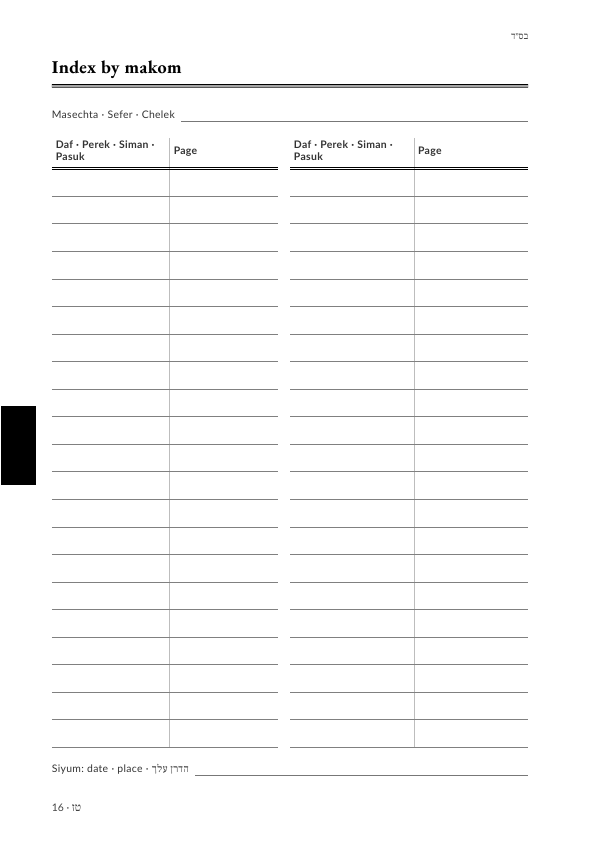
  7. Index by makom at the back: give each masechta, sefer or chelek you learn its own index page, and write the daf, siman or pasuk with the page.
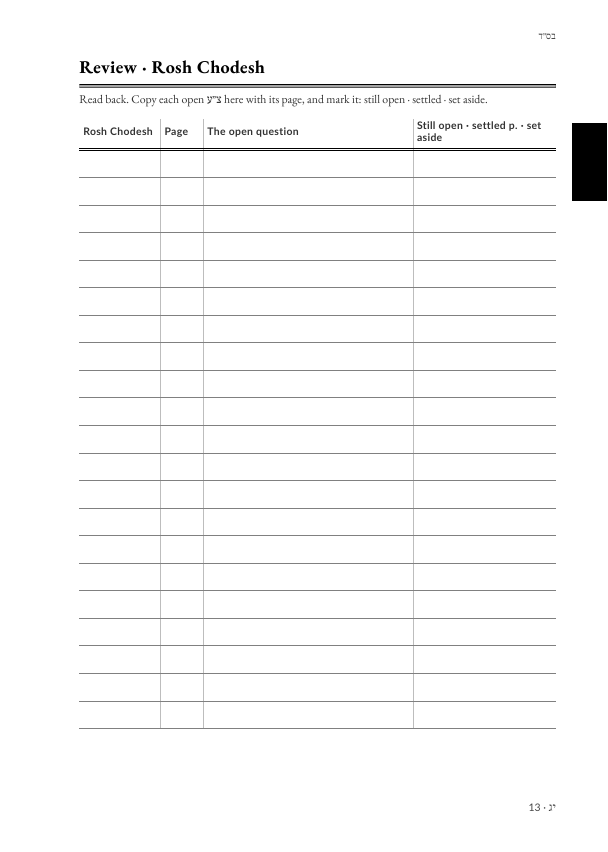
  8. Review every Rosh Chodesh. Read back, copy each open צ״ע to the review page, and mark it: still open · settled · set aside. When the volume is full, carry what is still open into the next one.
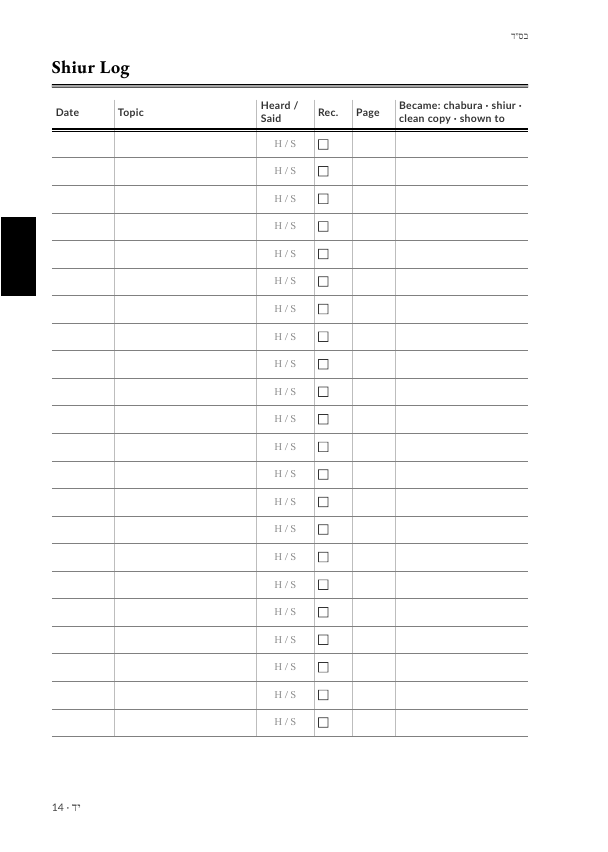
  9. Log what an entry becomes: a chabura, a shiur, a clean copy, shown to your rebbe or teacher.

Where each rule comes from, with its source: The Tradition. The method is free to use and teach; the guide is free to share: Use & licence.

Printable: the method on one page, A5, to keep inside your Pinkas (PDF) · the method and marks pages exactly as printed in the book.

RULES 1–3

One book, the entry line, the margin

Your own ideas and what you hear go into the same book, page after page. Every entry opens with one line: date · makom · source, where the source is your own reasoning or שמעתי מ־ and a name. Never blur what you heard with what is yours.

The wide outer margin has two jobs: the makom, so you can find an entry by turning pages, and הגהות, what you add later, dated. Real pinkasim fill their margins over years; this book makes room for it.
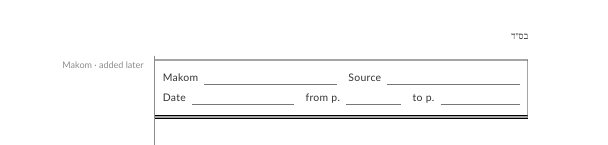
The entry line at the top of every writing page.
RULE 4

The marks

Not a new code: the abbreviations the seforim already use. Keep entries short; one he’ara on a daf is enough. Close each entry with העולה, the conclusion in one line.

קשה / ק״לa question
וי״לan answer
נ״ל / ולכאורהmy own reasoning (ולכאורה: tentative)
צ״עleft open: goes to the review page
וצ״בneeds explaining
שמעתי מ־ / בשםheard from: write the name
עי׳ לעיל / לקמןsee page: write → p. or ← p.
הגה״הadded later: in the margin, dated
העולהthe conclusion, in one line: closes the entry

Chazal: אין תורה נקנית אלא בסימנין (Eruvin 54b).

RULES 5–6

What a sevara rests on · threading

Note the Gemara or Rishon a sevara rests on; if you have none yet, write צ״ע, and it waits for the review. When an entry continues or connects, write → p. at the old entry and ← p. at the new one; the header of every writing page has room for both.

RULE 7

The index by makom

At the back, give each masechta, sefer or chelek you learn its own index page, and write the daf, perek, siman or pasuk with the page. Each page ends with a siyum line. A second index is already printed with every parsha and moed, and a third collects topics.

An index page, assigned by the owner.
RULE 8

The Rosh Chodesh review

Once a month, read back. Copy each open צ״ע to the review page with its page number, and mark it: still open, settled, or set aside. When the volume is full, the closing page carries what is still open into the next one.

Missed a Rosh Chodesh? Review at the next one. Nothing is lost; the open questions wait for you.

The review page.
The review page.
RULE 9

What an entry became

The shiur log records shiurim heard and given, whether they were recorded, and what an entry became: a chabura, a shiur, a clean copy, or something you showed your rebbe or teacher.

The shiur log.
The shiur log.

The special pages

Shiur & chabura prep

A facing spread: the main question, the flow with its sources, the mareh mekomos to hand out, what to cut if time runs short, and notes after.

Motzei Shabbos & Yom Tov

Written up after Shabbos or Yom Tov: what you heard (מפי and where), what you said, and a vort for the table.

Questions & answers

Exam questions, sheilos, questions from a shiur: what was asked, what you answered, and the din with its source.

The shelf

Each Pinkas is one volume. The spine and cover take a subject and a volume number, and the closing page lists your volumes, so a row of them becomes a numbered set you can search by makom.

Glossary

Makom
Where you are learning: Berachos 12a, Parshas Noach, Orach Chaim 1.
Sevara
A line of reasoning.
He’ara
One observation.
Hagahah (הגה״ה)
An addition written later, in the margin, with its date.
Tzarich iyun (צ״ע)
A question left open; it goes to the review page.
Ha’oleh (העולה)
The conclusion, in one line, that closes an entry.